
India’s digital economy is expanding rapidly, but cyber threats are evolving even faster. In 2026, businesses are not just dealing with ordinary hacking attempts anymore, they are facing AI-powered attacks, deepfake frauds, ransomware syndicates, and highly advanced cybercriminal networks.
From startups to large enterprises, every organization is now a target.
Cybersecurity is no longer only an IT responsibility. It has become a critical business necessity.
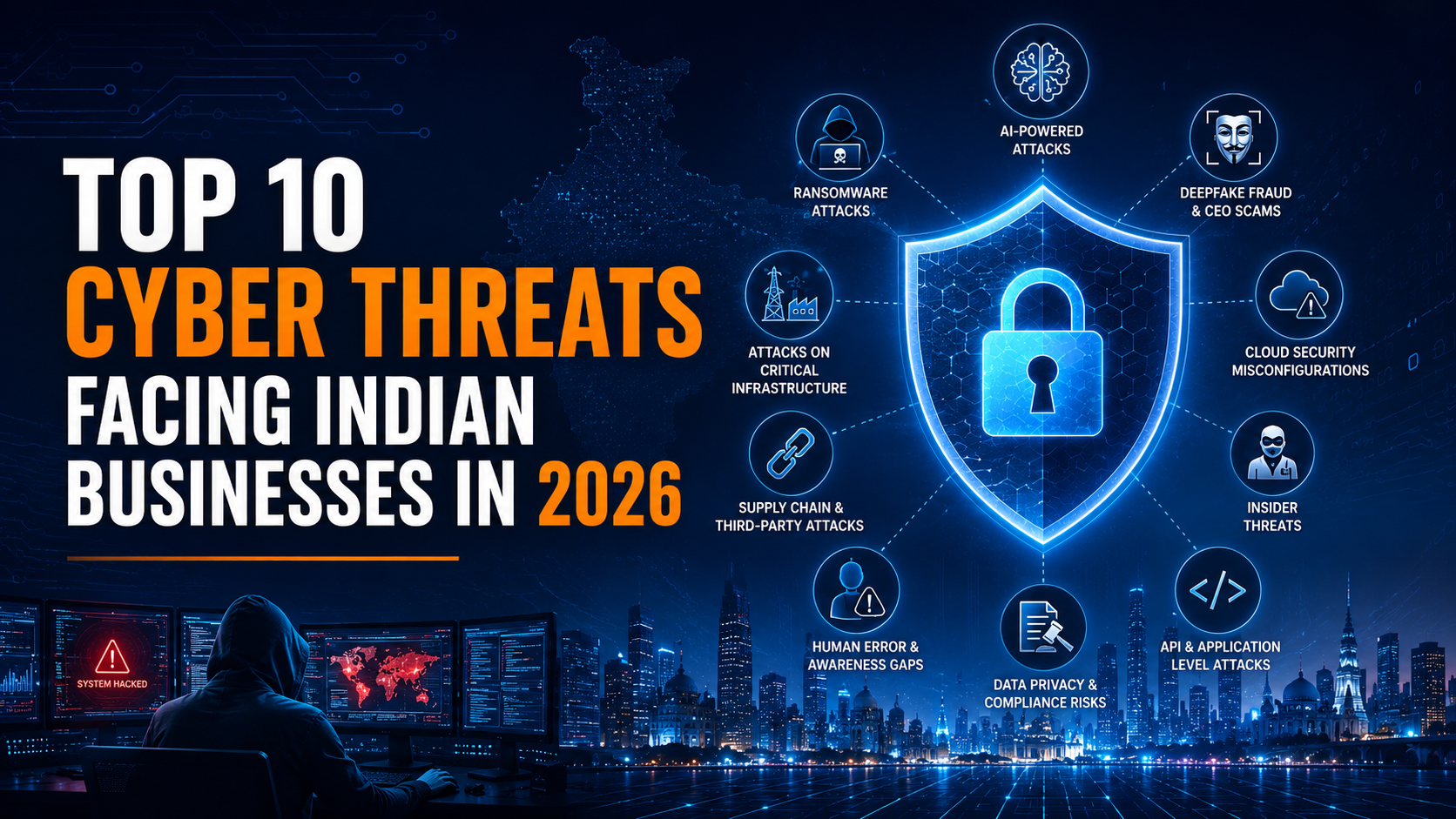
Here are the top cyber threats Indian businesses must prepare for in 2026.
1. AI-Powered Cyber Attacks
Cybercriminals are increasingly using Artificial Intelligence to launch faster, smarter, and more personalized attacks against businesses.
Attackers are using AI to:
- Generate highly convincing phishing emails that look almost identical to genuine business communication.
- Automate malware creation, making cyberattacks faster and more difficult for traditional security tools to detect.
- Scan vulnerabilities at massive scale and identify weak systems within minutes before organizations can respond.
- Mimic employee communication patterns to manipulate teams through highly personalized social engineering attacks.
Businesses relying only on traditional security tools may struggle to defend against these evolving threats.
2. Ransomware Attacks
Ransomware continues to remain one of the biggest cybersecurity threats for Indian businesses in 2026.
Modern ransomware groups often:
- Encrypt critical business files and completely disrupt day-to-day operations within hours.
- Steal sensitive data before encryption and threaten organizations with public data leaks.
- Target backup systems first, making recovery significantly more difficult for businesses.
- Demand massive ransom payments while causing operational, financial, and reputational damage simultaneously.
Manufacturing, healthcare, logistics, and financial sectors continue to remain major targets.
3. Deepfake Fraud & CEO Scams
Deepfake technology is rapidly becoming a dangerous tool for cybercriminals targeting organizations and leadership teams.
Attackers are now able to:
- Clone executive voices to create fake urgent payment or fund transfer requests.
- Produce realistic deepfake videos impersonating CEOs, directors, or senior management.
- Manipulate employees into sharing confidential business information through fake communication.
- Launch highly convincing Business Email Compromise (BEC) attacks using AI-generated content.
Businesses must strengthen internal verification processes before approving sensitive actions.
4. Supply Chain & Third-Party Attacks
Attackers are increasingly targeting vendors and third-party partners to gain access to larger organizations.
Common third-party targets include:
- Software vendors that have access to critical business systems and sensitive customer data.
- IT service providers managing infrastructure, networks, or remote business operations.
- Cloud partners with weak security configurations and poor access management controls.
- Outsourced teams handling business-critical operations without proper cybersecurity standards.
One vulnerable vendor can expose an entire organization to serious cyber risks.
5. Cloud Security Misconfigurations
As businesses rapidly move towards cloud infrastructure, security misconfigurations are becoming a major cause of data breaches.
Common cloud security issues include:
- Exposed databases that unintentionally allow public access to sensitive information online.
- Weak identity and access controls that give unnecessary permissions to users and applications.
- Poorly secured APIs that attackers exploit to gain unauthorized access into systems.
- Misconfigured cloud storage environments exposing confidential customer and business data.
Many cyber incidents happen because of simple security mistakes rather than advanced hacking techniques.
6. Insider Threats
Not every cybersecurity threat comes from outside the organization. Internal users can also create serious risks.
Insider threats commonly involve:
- Employees accidentally exposing sensitive data through negligence or unsafe digital practices.
- Former staff members retaining unnecessary system access even after leaving the organization.
- Misuse of privileged accounts to access confidential business information without authorization.
- Internal users bypassing security controls for convenience, increasing organizational vulnerabilities.
Strong access management and monitoring are essential to reducing insider risks.
7. Attacks on Critical Infrastructure
Critical infrastructure sectors are becoming major targets for sophisticated cyberattacks in 2026.
High-risk industries include:
- Manufacturing facilities that rely heavily on connected industrial and operational technology systems.
- Power and energy organizations managing critical infrastructure supporting millions of users daily.
- Transportation and logistics companies handling supply chains and nationwide operational networks.
- Healthcare institutions managing highly sensitive patient data and critical medical systems.
A successful cyberattack on critical infrastructure can disrupt operations and impact public safety.
8. API & Application-Level Attacks
Applications and APIs have become one of the largest attack surfaces for modern businesses.
Cybercriminals commonly exploit:
- Weak authentication mechanisms allowing unauthorized access to critical business applications.
- Insecure coding practices that introduce vulnerabilities into customer-facing digital platforms.
- Unprotected APIs exposing sensitive business data and backend services to attackers.
- Injection attacks used to manipulate databases, applications, and business operations.
Organizations must integrate security into the software development lifecycle from the beginning.
9. Data Privacy & Compliance Risks
With evolving data protection regulations, businesses can no longer afford weak governance and poor security practices.
Organizations may face:
- Heavy financial penalties due to failure in protecting customer and organizational data.
- Regulatory investigations following major security breaches or privacy compliance failures.
- Reputation damage that directly impacts customer trust and long-term business growth.
- Legal and operational challenges caused by improper handling of sensitive information.
Cybersecurity and compliance must work together to build digital trust and resilience.
10. Human Error & Cybersecurity Awareness Gaps
Human error continues to remain one of the biggest reasons behind successful cyberattacks worldwide.
Common employee mistakes include:
- Clicking phishing links disguised as genuine business emails or urgent notifications.
- Reusing weak passwords across multiple business accounts and digital platforms.
- Sharing sensitive credentials unknowingly with attackers during social engineering attempts.
- Ignoring organizational cybersecurity policies and basic digital safety practices.
Building a strong cybersecurity awareness culture is now more important than ever.
Final Thoughts
Cyber threats in 2026 are no longer just technology problems — they are business risks that impact operations, reputation, customer trust, and long-term growth. Organizations that invest in proactive cybersecurity, employee awareness, modern security infrastructure, and continuous monitoring will be far better prepared for the future.
The question is no longer “Will your organization face a cyberattack?”
The real question is:
“How prepared are you when it happens?”
MD & CEO, Threatsys Technologies; Entrepreneur, Cybersecurity Expert, Lead Auditor, TedxSpeaker; CISA, CISSO, CCISO, CPENT, LPT, CIPP, CPTE, CEH, ISO 27001 LA, CHFI, ECSA.