
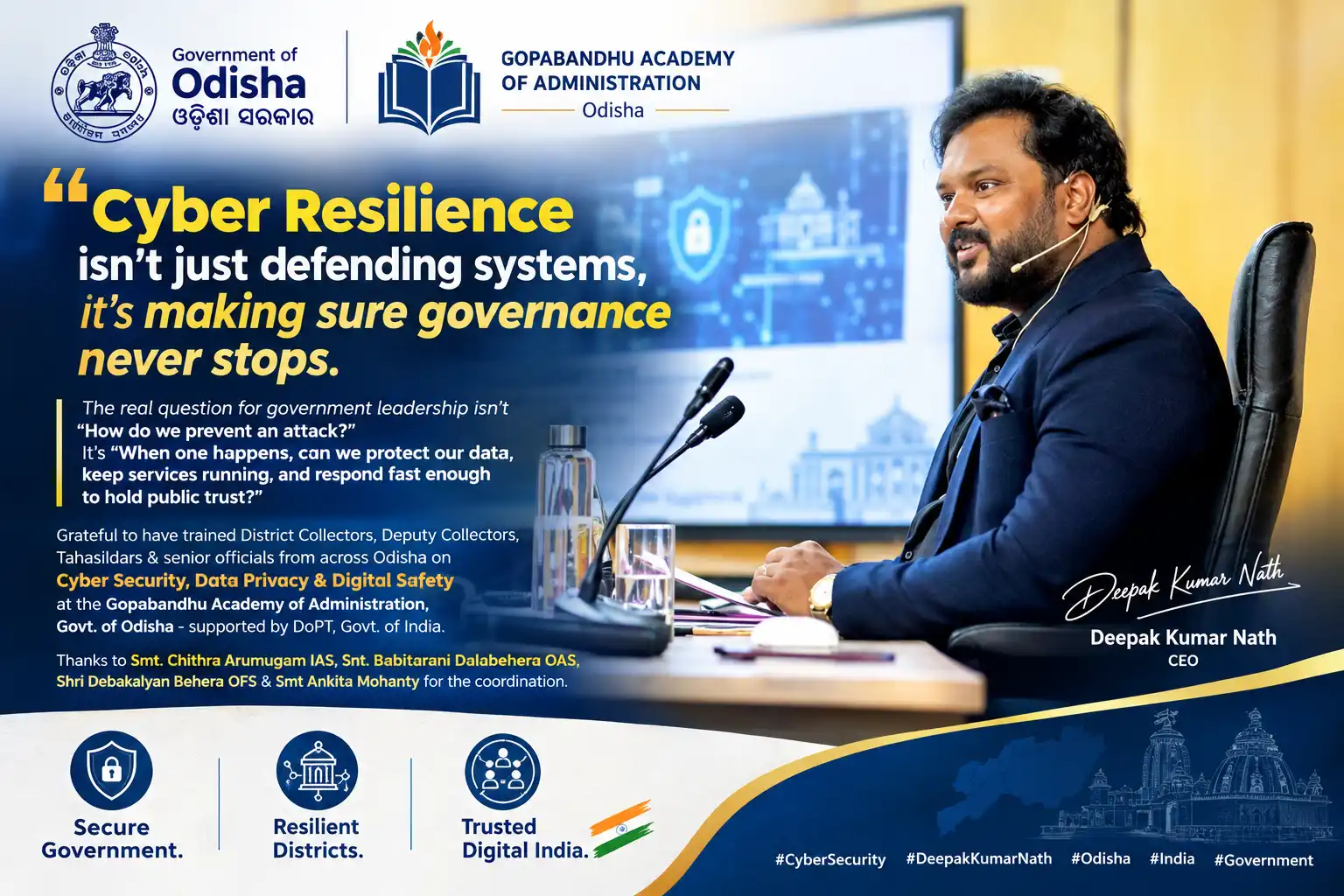

Cyber resilience in government is about more than defending systems from attacks. It is about making sure governance keeps working when challenges arise.
As public services move online, government institutions handle large volumes of sensitive information and deliver critical services through technology. That makes cybersecurity, data privacy and digital safety essential parts of modern governance.
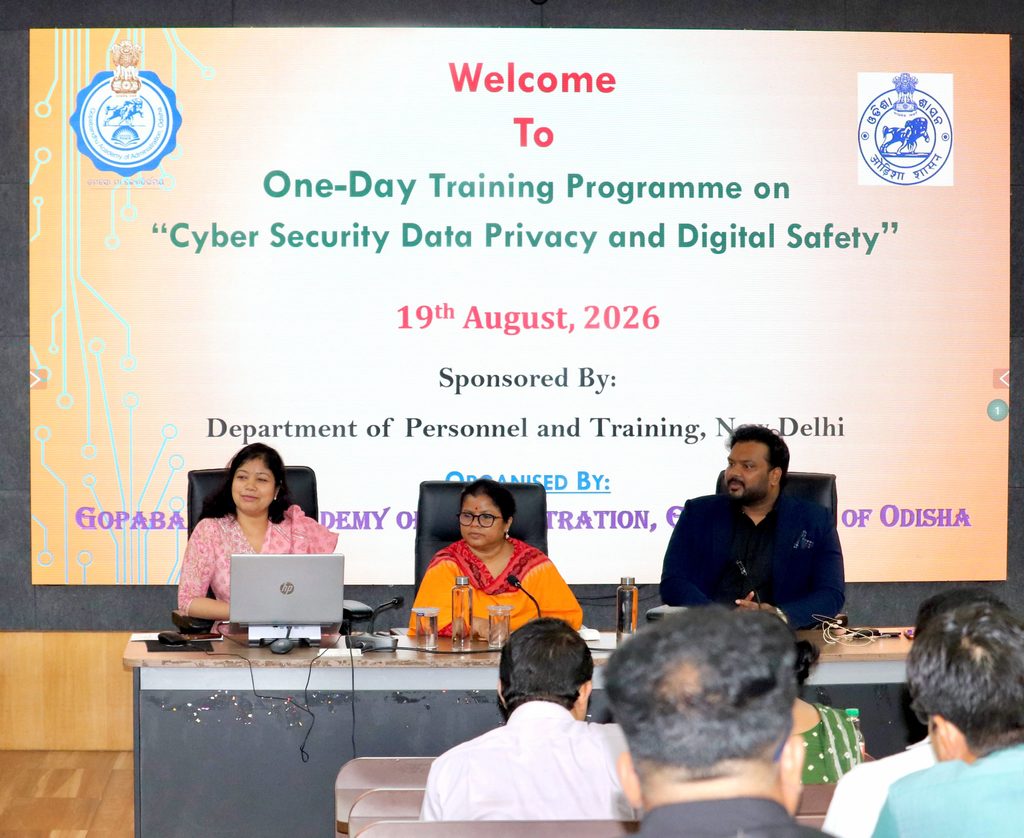
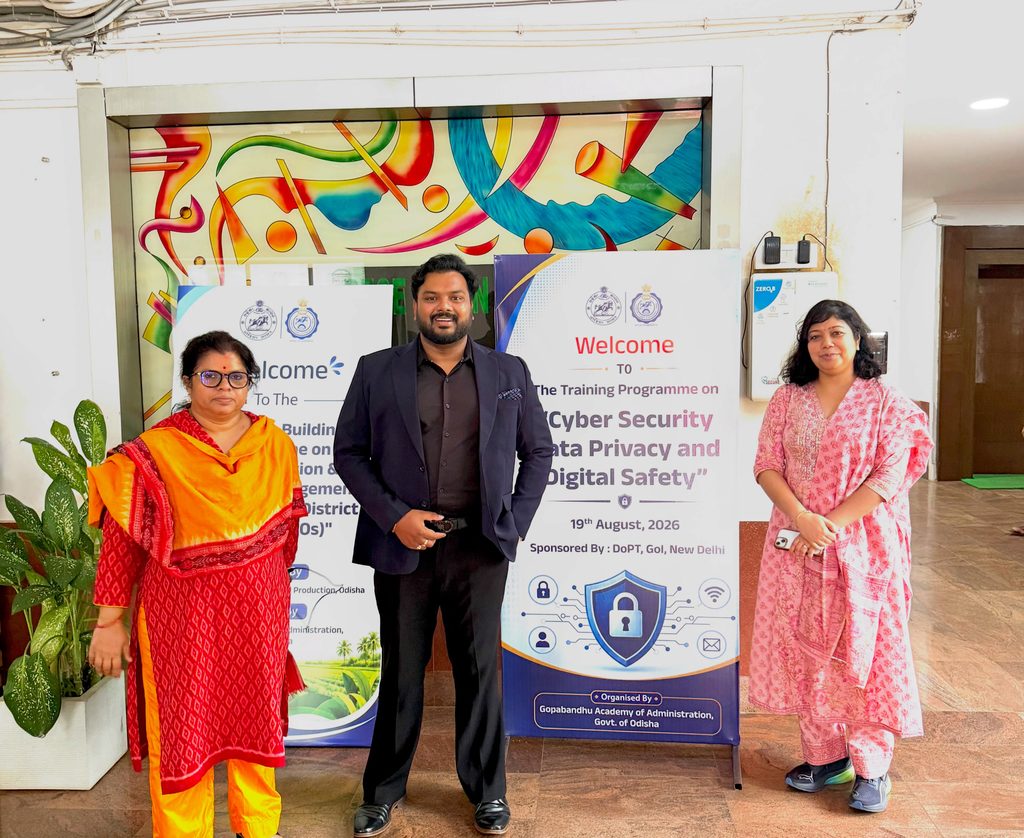
On 19 August 2026, I had the privilege of contributing to this conversation at a one day training programme on “Cyber Security, Data Privacy and Digital Safety” at the Gopabandhu Academy of Administration, Government of Odisha. The programme was sponsored by the Department of Personnel and Training (DoPT), Government of India, and organised by the Academy.
Moving Beyond Cyber Defence
A question that keeps shaping my thinking is this: when a cyber incident happens, can an organisation protect its data, keep essential services running and respond fast enough to hold on to public trust?
For government institutions, the answer matters even more. Cyber resilience means preparing not only to prevent attacks, but also to detect incidents early, respond well, recover operations and learn from every disruption. A strong strategy brings together technology, governance, people and processes.
Cybersecurity Is a Governance Responsibility
I spoke with District Collectors, Deputy Collectors, Tahasildars and senior officials from across Odisha. My central message was simple: cybersecurity cannot stay with IT teams alone.

Officials make decisions every day that shape how information is collected, accessed, shared and protected. One compromised account, phishing email, weak password or accidental disclosure can have consequences far beyond the technology. This is why cyber awareness and responsible digital habits must become part of everyday governance.
Protecting Data and Public Trust
Government departments hold highly sensitive information, and protecting it takes more than technical controls. It needs clear processes for access, sharing, storage, accountability and responsible use.
Digital safety also depends on people. Officials and employees need to recognise suspicious emails, social engineering attempts, unsafe links and fraudulent messages. Technology offers strong protection, but informed people remain one of the most important layers of defence.
From Prevention to Resilience
A resilient institution prepares for every stage of an incident:
Prepare → Prevent → Detect → Respond → Recover → Learn
Preparation starts with understanding critical systems and information. Prevention means putting suitable security controls in place. Detection helps spot suspicious activity early. Response focuses on containing the incident and limiting its impact. Recovery brings essential services back to normal. Learning strengthens defences for the future.
This shifts the question from “How do we stop every attack?” to “How prepared are we when something goes wrong?” No organisation can assume it will never face an incident. The goal is to ensure that an incident does not bring governance and public services to a standstill.
Strengthening Cyber Awareness Across Districts
District administration plays a vital role in delivering public services. As more processes depend on technology, cybersecurity awareness at the district level matters more than ever.
Programmes like this let us discuss cybersecurity in the context of real administrative responsibilities, rather than as a purely technical subject. The aim is to help decision makers understand the risks, recognise their role and make cybersecurity part of everyday governance.

Grateful for the Opportunity
I am grateful for the chance to engage with government officials on these important topics. My sincere thanks to Smt. Chithra Arumugam IAS, Smt. Babitarani Dalabehera OAS, Shri Debakalyan Behera OFS and Smt. Ankita Mohanty for their coordination and support in making the programme possible.
The discussions reinforced a belief I hold strongly: cyber resilience is ultimately about people, preparedness and continuity. A secure digital government is not simply one with strong technology. It is one that can protect information, respond to threats, keep essential services running and earn the trust of its citizens.
Conclusion
This training programme reinforced a simple truth: cybersecurity is now a core part of good governance. Protecting government data, keeping digital services running and responding quickly to cyber incidents all depend on awareness, preparedness and teamwork at every level of administration.
I am grateful for the opportunity to share my experience on Cyber Security, Data Privacy and Digital Safety with the dedicated officials of Odisha. Their engagement and commitment were truly encouraging. By strengthening cyber awareness and building resilience into everyday governance, we can move towards secure government, resilient districts and a more trusted Digital India.
Secure Government. Resilient Districts. Trusted Digital India. 🇮🇳🛡️
About the Author
Deepak Kumar Nath — MD & CEO, Threatsys Technologies; Entrepreneur, Cybersecurity Expert, Lead Auditor, TedxSpeaker; CISA, CISSO, CCISO, CPENT, LPT, CIPP, CPTE, CEH, ISO 27001 LA, CHFI, ECSA.